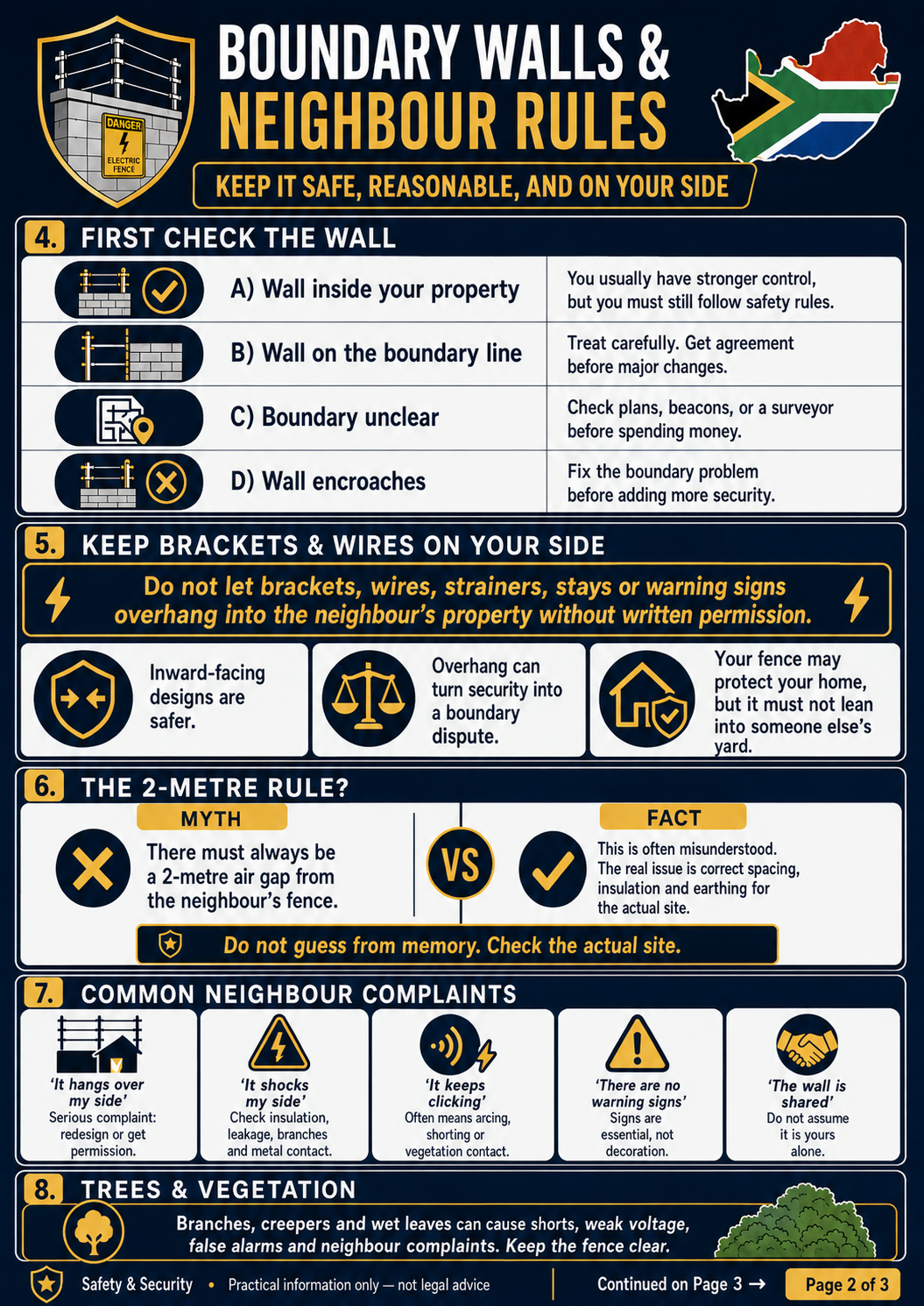
You have the right to protect your property. But your electric fence must stay on your side, respect the boundary, avoid nuisance, follow electric fence safety rules, and not become a dangerous trap. This guide explains the boundary-wall side of the problem in plain language.
The strong position is not “my neighbour must accept everything.” The strong position is: “my fence is reasonable, safe, legal, and on my side.”
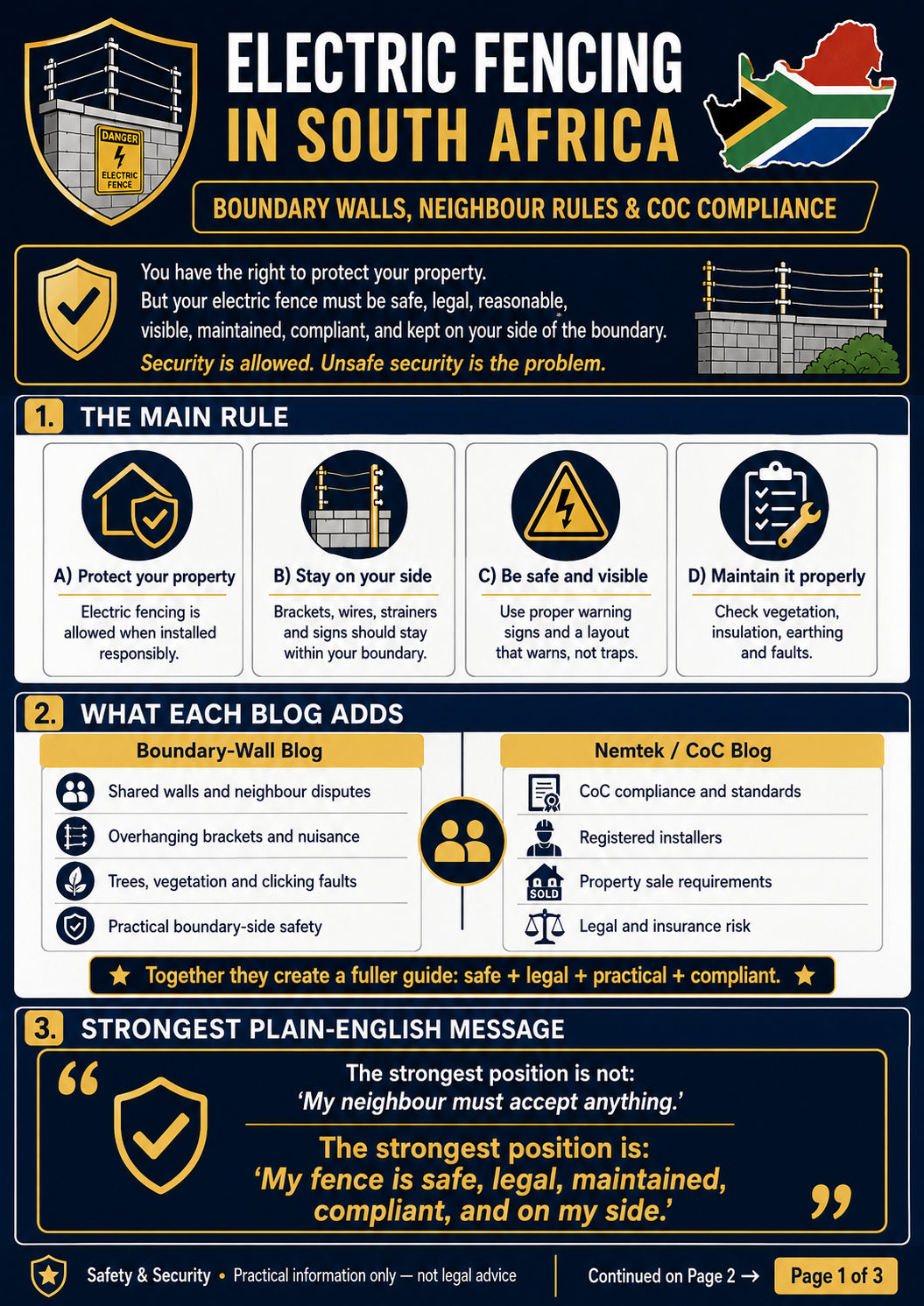
You are allowed to protect your home. But your fence must stay on your side. It must be put up safely. It must have warning signs. It must not hang over into your neighbour’s yard. It must not be changed into something dangerous.
An electric fence should warn someone and make them move away. It should not be built like a trap.
A property owner may secure their property, but the installation must be reasonable. The fence should remain within the property boundary, comply with electric fence safety rules, carry proper warning signs, avoid unsafe modifications, and avoid becoming a nuisance to neighbours.
This article focuses on boundary-wall and neighbour problems. For the full certificate discussion, use the dedicated Electric Fence CoC guide.
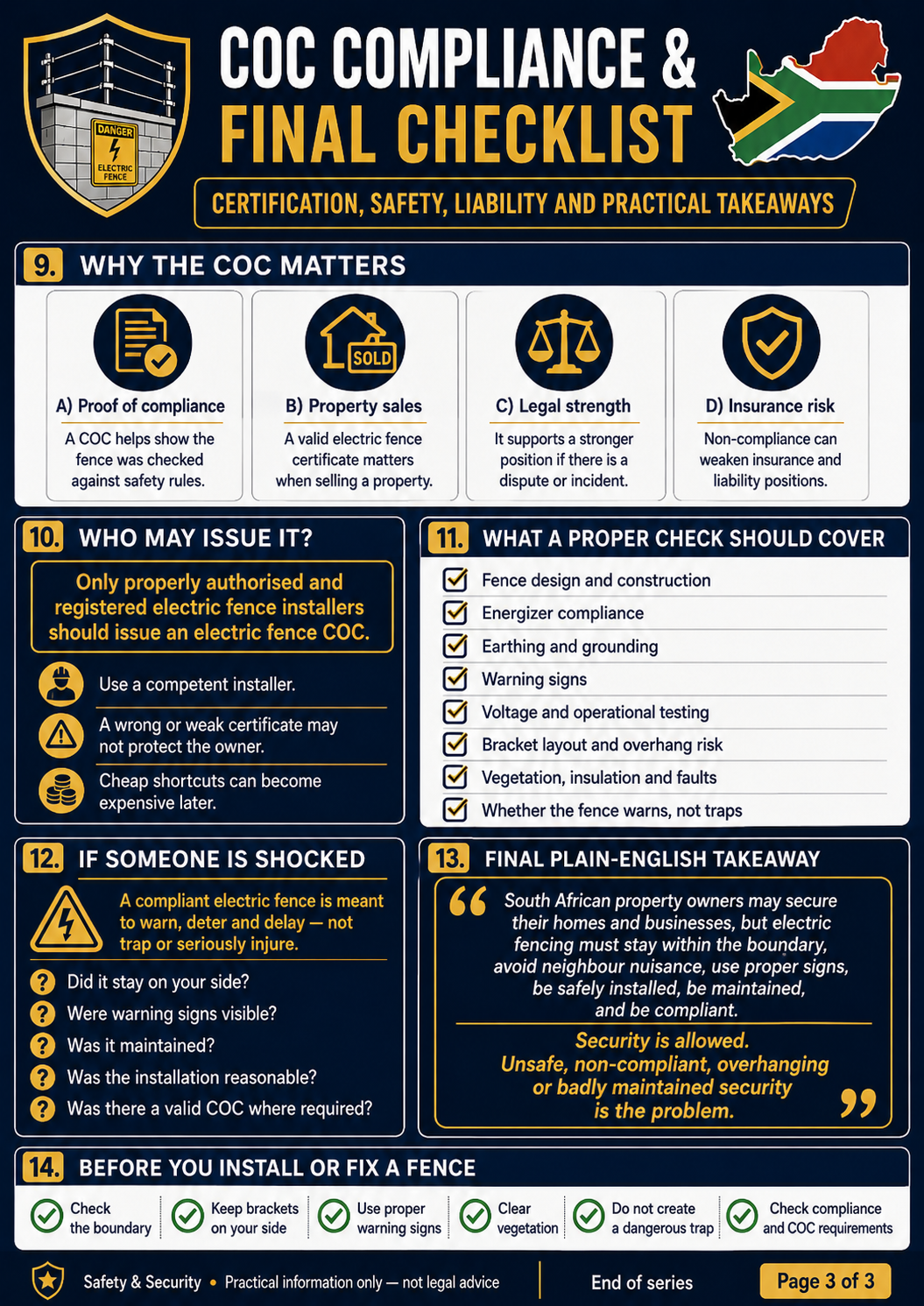
Many disputes start because people say “my wall” without first checking where the boundary line actually is. A wall may be fully inside one property, built on the boundary line, or even slightly over the wrong side because of an old mistake.
| Situation | Practical meaning | Safer action |
|---|---|---|
| Wall fully inside your property | You usually have stronger control over it, but you must still follow bylaws and safety rules. | Keep all brackets and wires inside your boundary. |
| Wall on the boundary line | It may be treated as a shared or party wall. Major changes can cause disputes. | Get written agreement before major changes. |
| Boundary unclear | The fence line may not be the legal boundary line. | Check plans, beacons or get a surveyor before spending money. |
| Wall encroaches | A wall over the boundary can become a serious legal problem. | Fix the boundary issue before adding more security onto it. |
This is one of the cleanest practical rules: keep the electric fence on your side. Angled brackets, wires, strainers, stays, warning signs and cable routes should not invade the neighbour’s property without written permission.
Even if your security reason is valid, an overhang can turn a security job into a boundary dispute. The safer design is usually inward-facing brackets or a design that stays clearly within your side of the property.
People often ask whether there must be a two-metre physical gap between an electric fence and the neighbour’s ordinary fence. That is usually not the correct way to understand the issue.
In many electric fence discussions, the spacing issue is about earthing systems and separation from other earths, not a blanket rule saying every neighbour’s fence needs a two-metre air gap. Arcing normally happens over short distances when something is too close, damaged, wet or badly insulated.
A neighbour may dislike the look, but security can still be reasonable if it is lawful, safe and within your boundary.
This is a serious complaint. If it crosses the boundary, redesign the bracket layout or get written permission.
Check insulation, vegetation, earth leakage paths, wet branches and metal contact points. Do not ignore this complaint.
Continuous clicking often means shorting, arcing, vegetation contact or a fault. That can become nuisance and maintenance evidence.
Warning signs are not decoration. They show the fence is meant to warn, not surprise people.
If the wall is on the boundary line, do not treat it as if it is automatically yours alone. Get agreement before major changes.
Trees, branches, creepers and wet leaves can cause shorts, clicking, weak voltage, false alarms and neighbour complaints. A fence can be legally installed and still become a problem if vegetation is left to grow into it.
If a branch from one property touches the electric fence on another property, the practical answer is not to start a fight first. First identify the source, take photos, speak calmly, and arrange trimming safely. Do not cut branches in a dangerous way around live wires.

This boundary-wall article does not repeat the full CoC injury scenarios. The short version is this: a compliant electric security fence is meant to warn, shock, deter and delay. It is not meant to be a trap or a device designed to seriously injure people.
If someone is hurt, the important boundary questions are: did the fence stay on the owner’s side, were warning signs visible, was accidental contact reasonably prevented, was the fence maintained, and was the installation reasonable?
Palisade fencing can cut or pierce because it is a hard physical barrier. Electric fencing works differently. A legal electric security fence should give a controlled warning shock and make the person move away.
If either system is hidden, dangerous, over the boundary, badly maintained or unreasonable, the owner’s position becomes weaker.
In Dorland v Smits, the dispute included an electric fence and neighbour complaints. The court did not treat the electric fence as an automatic nuisance. The practical lesson is not “do anything you want.” The practical lesson is that lawful, reasonable security is easier to defend than unsafe or excessive security.
Encroachment disputes show why beacons and boundary accuracy matter. A wall or fence in the wrong place can create a dispute far more expensive than checking the line properly before building.
South African property owners have a real reason to secure their homes and businesses. But the fence must be reasonable, safe, visible, maintained, and placed correctly.
If you have a dispute, overhang concern, vegetation problem, old fence, unclear bracket layout or shock complaint, get the system checked before the argument becomes bigger.
Safety & Security can inspect electric fencing, identify visible risks, check practical maintenance issues and advise on safer boundary-side corrections.
This article is practical information, not legal advice. Boundary disputes can depend on deeds, beacons, municipal bylaws, wall position, installation details and the facts of the dispute.